
The term “illuminati” has been used since the 15th century and was given to groups of people who claimed to have special knowledge or insight. The word comes from the Latin “illuminatus,” meaning “revealed” or “enlightened.”
Early illuminati
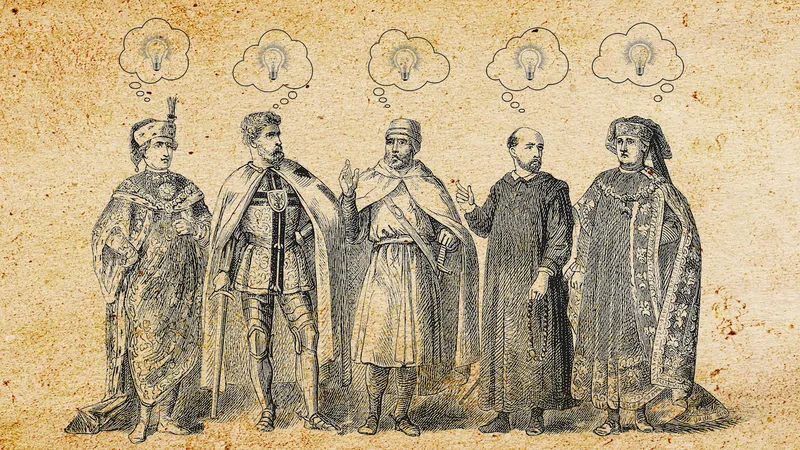
Is the Illuminati real? Learn more about the history and origins of the so-called Illuminati.
According to its followers, the source of the “light” was believed to come directly from a higher power or through a heightened and elevated state of human understanding.
One group that believed in this idea was the Alumbrados, which means “enlightened” in Spanish. The Spanish historian Marcelino Menéndez y Pelayo first mentioned the name around 1492, using the form “aluminados” in 1498.
He traced their beliefs back to Gnostic origins and thought their ideas spread in Spain through influences from Italy. One of their earliest leaders, and some scholars even call her a “pre-Alumbrado,” was María de Santo Domingo, known as La Beata de Piedrahita. She was the daughter of a laborer, born in Aldeanueva, south of Salamanca, around 1485.
She joined the Dominican order as a teenager and soon became famous as a prophet and mystic who claimed to speak directly with Jesus Christ and the Virgin Mary. Ferdinand of Aragon invited her to his court, and he became convinced of the truth in her visions.
The Dominicans asked Pope Julius II for guidance, and a series of trials were held under the Inquisition. Her supporters, which included not only Ferdinand but also Francisco Cardenal Jiménez de Cisneros and the Duke of Alba, made sure no decision was made against her, and she was finally cleared in 1510.
St. Ignatius of Loyola
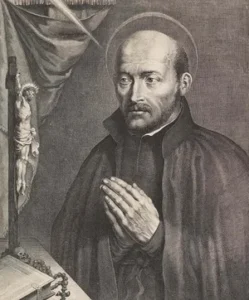 St. Ignatius of Loyola, while studying at Salamanca in 1527, was questioned by a religious authority on the charge of being sympathetic to the Alumbrados, but he only received a gentle reprimand. Others were not as lucky. In 1529, a group of followers in Toledo who were not well-educated faced beatings and imprisonment. Harsher punishments came later, and for about a hundred years, the Alumbrados were often targeted by the Inquisition, especially in Cordoba.
The movement, known as the Illuminés, appeared in France from Seville in 1623.
It gained some attention in Picardy when Pierre Guérin, a priest from Saint-Georges de Roye, joined it in 1634. His followers, called the Guerinets, were eventually stopped in 1635. Another group of Illuminés appeared in the southern part of France in 1722 and lasted until 1794. They had some connections with the “French Prophets,” a group that was related to the Protestant militant Camisards at that time.
Robert Fludd
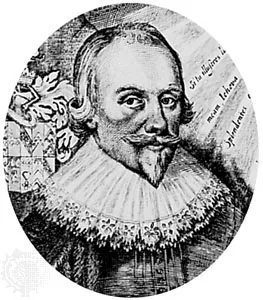 Robert Fludd, detail of an engraving from Integrum Morborum Mysterium, 1631.
The Rosicrucians were a different kind of group.
They claimed to have started in 1422 but first gained public attention in 1537. Their beliefs mixed elements of Egyptian Hermetism, Christian Gnosticism, Jewish Kabbalah, alchemy, and other mystical traditions. The earliest known writing about the Rosicrucian order was the Fama Fraternitatis, published in 1614, though it might have been shared in manuscript form before that. The text tells the story of Christian Rosenkreuz, the supposed founder of the group, who traveled to Damascus, Damcar—a mythical city in Arabia—Egypt, and Fez, where he was welcomed and gained access to a lot of secret knowledge.
He eventually returned to Germany, where he selected three others to pass on this wisdom, thus starting the order. Later, the number of members grew to eight, each going to a different country. One of the group’s six agreements was that they would remain secret for 100 years. After 120 years, one of the members found the secret burial place of the founder, along with his well-preserved body and some important documents and symbols. The sacred vault was closed again, the members of the order dispersed, and the location of the vault was lost to history. The *Fama* finishes by inviting “some few” to join the brotherhood. Among those thought to be connected to the order were the German alchemist Michael Maier, the British physician Robert Fludd, and the British philosopher and statesman Sir Francis Bacon.
The Bavarian illuminati
Perhaps the group most closely associated with the name illuminati was a short-lived movement of republican free thought founded on May Day 1776 by Adam Weishaupt, professor of canon law at Ingolstadt and a former Jesuit. The members of this secret society called themselves “Perfectibilists.” Their founder’s aim was to replace Christianity with a religion of reason, as later did the revolutionaries of France and the 19th-century positivist philosopher Auguste Comte. The order was organized along Jesuit lines and kept internal discipline and a system of mutual surveillance based on that model. Its members pledged obedience to their superiors and were divided into three main classes: the first included “novices,” “minervals,” and “lesser illuminati”; the second consisted of freemasons (“ordinary,” “Scottish,” and “Scottish knights”); and the third or “mystery” class comprised two grades of “priest” and “regent” as well as “magus” and “king.”
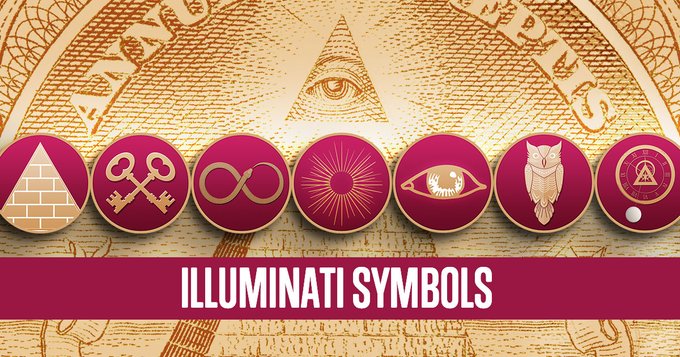
Beginning with a narrow circle of disciples carefully selected from among his own students, Weishaupt gradually extended his recruitment efforts from Ingolstadt to Eichstätt, Freising, Munich, and elsewhere, with special attention being given to the enlistment of young men of wealth, rank, and social importance. From 1778 onward Weishaupt’s illuminati began to make contact with various Masonic lodges, where, under the impulse of Adolf Franz Friedrich, Freiherr von Knigge, one of their chief converts, they often managed to gain a commanding position, It was to Knigge that the society was indebted for the extremely elaborate constitution (never, however, actually realized) as well as its internal communication system. Each member of the order had given him a special name, generally classical, by which he alone was addressed in official writing (Weishaupt was referred to as Spartacus while Knigge was Philo). All internal correspondence was conducted in cipher, and to increase the mystification, towns and provinces were invested with new and altogether arbitrary designatiop.
Johann Wolfgang von Goethe
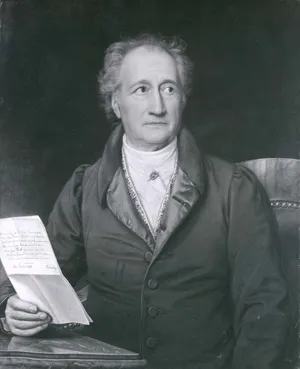 Johann Wolfgang von Goethe, oil painting by Joseph Karl Stieler, 1828; in the Neue Pinakothek, Munich.
Johann Gottfried von HerderJohann Gottfried von Herder, detail of an oil painting by Gerhard von Kügelgen, 1808; in the Library of Tartu State University, Estonia. At its period of greatest development, Weishaupt’s “Bavarian Illuminati” included in its operations a very wide area, extending from Italy to Denmark and from Warsaw to Paris; at no time, however, do its numbers appear to have exceeded 2,000. The order and its doctrines appealed to literary giants such as Johann Wolfgang von Goethe and Johann Gottfried von Herder as well as the dukes Ernest II of Gotha and Charles Augustus of Saxe-Weimar-Eisenach. Such notables were claimed as members although it is questionable if they were actually so. Weishaupt’s illuminati were believed to have included astronomer Johann Bode, writer and bookseller Friedrich Nicolai, philosopher Friedrich Jacobi, and poet Friedrich Leopold, Graf zu Stolberg-Stolberg.
Secret societies of this kind fitted in with the idea of benevolent despotism as a vehicle for the Enlightenment, as Goethe shows in Wilhelm Meister’s Apprenticeship. The movement suffered from internal dissension and was ultimately banned by an edict of the Bavarian government in 1785. Some members were imprisoned, while others were driven from their homes. Weishaupt was stripped of his chair at Ingolstadt and banished from Bavaria. After 1785 the historical record contains no further activities of Weishaupt’s illuminati, but the order figured prominently in conspiracy theories for centuries after its disbanding. It was credited with activities ranging from the instigation of the French Revolution to the assassination of U.S. Pres. John F. Kennedy, and the notion of an all-knowing cabal of ancient masters remained a powerful image in the popular consciousness into the 21st century.
 Later illuminati
After the suppression of Weishaupt’s order, the title illuminati was given to the French Martinists, founded in 1754 by Martinez Pasqualis and propagated by Louis-Claude de Saint-Martin. By 1790 Martinism had been spread to Russia by Johann Georg Schwarz and Nikolay Novikov. Both strains of “illuminated” Martinism included elements of Kabbalism and Christian mysticism, imbibing ideas from Jakob Böhme and Emanuel Swedenborg.